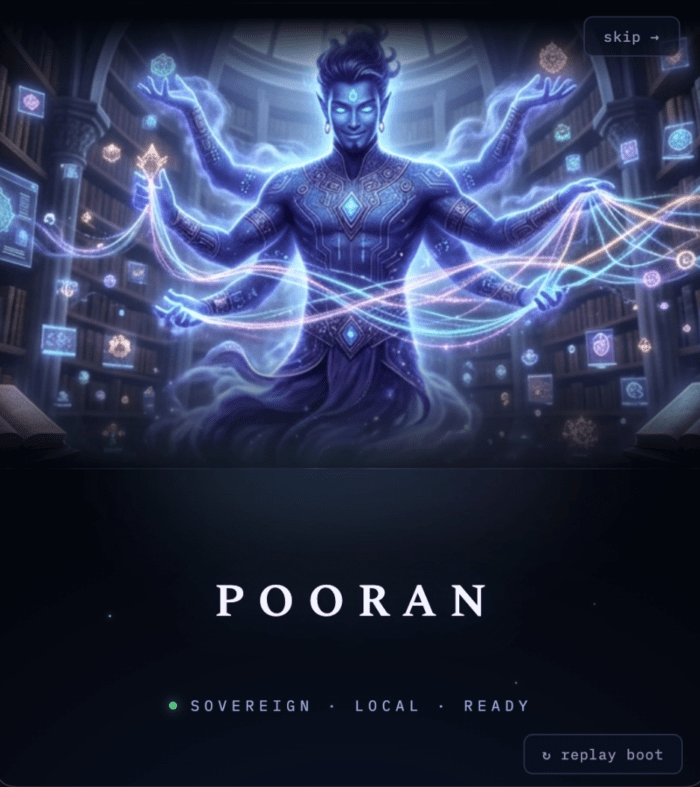
The House of Pooran – Building My Sovereign Ai
My Mac mini arrived ahead of schedule — and, more importantly, before the price hike. The joy of saving on the price somehow fully compensated for the pain of the price of that 24GB Mac mini with the M4 Pro chip. The mind is a wonderful accountant.
It came with the promise of sovereign AI — my own local model, running on my own machine, in my own house, with no need for even the internet. Free. Unlimited tokens. No subscription meter running in the background, no data leaving the premises. AI for the price of electricity. I was soon to find out the reality of it, versus the hype. In any case, I needed an upgrade from my M1 MacBook Air, which was not coping well with my demands of photography and video editing.
It was a lovely overcast weekend. I had reconciled to seeing the monsoons halfway through before the machine arrived — there had been a big rush of orders after WWDC, where the M5 Mac mini was not announced, and a lot of people like me, who had postponed the purchase waiting for it, gave up together. But it arrived thirty days early, unceremoniously wrapped in a carton like some dessert I had ordered — a little aluminium box that would be my creative powerhouse for the next few years. Outside, the rain had settled into its season-long assault on the city. Inside, I got busy bringing something to life.
A Tinkerer’s Toy
I unboxed the machine, installed Ollama, and watched my first fully local AI come alive. It wasn’t going to challenge any of the frontier models, but it was somehow more thrilling – a tech tinkerer’s toy, almost like growing your own tomato on the balcony while the sabziwala stands fifty metres away!
Then the reality of its limitations hit home. It couldn’t search the internet. It couldn’t even read or write files on my own machine. I would need to build tools to give it those capabilities — and that meant building an interface through which I could interact with my model. It was now a fun project too; the vibe-coder in me was excited. So I did the most important thing a vibe-coder does when taking on a project: I spent half a day thinking of a name.
I imagined it as my AI assistant, my sidekick — the thing that helps me around my areas of interest, the handyman who does the heavy lifting and the gruntwork. Then I remembered Pooran, a guy who once worked at my house — a guy I remember because he was so efficient, and also because he still owes me money. In his honour, I decided to call it Pooran. The name also means “to complete the work,” and carries an ancient, mystical vibe that goes with what I was building. Somewhere between those two facts — the efficiency and the real cost (that loan above and beyond the salary) — sits everything you need to know about the risks of hiring a helper, even a digital one.
Curb Your Enthusiasm
I opened the free tier of ChatGPT and gave it my brief. It heard me out. And then it got more excited than I was. It didn’t take long for the AI to decide that a “chat” was beneath the occasion. It began by firing itself as an assistant:
"From this point onwards, I'm going to act less like an AI assistant and more like the lead software architect sitting beside you."
I had not asked for a lead software architect. I had asked how to organise some folders.
I let its quirks be, and built out my specs a bit more — a way to organise information and files. But the AI had more faith in me than probably I had in myself, and it moved the scope further than anything I was planning:
"We are not writing an AI application. We are writing an Operating System. That changes every design decision."
Yeah, every design decision. All four of them.
As I wrote Pooran’s configuration files — the thing that helps him retain context and sets his behaviour every time he boots up, squeezing the most out of the limited context a local LLM allows — ChatGPT decided we were closer to creating a living being than I had imagined:
"Think of config as Pooran's DNA. When Pooran wakes up, the first thing it asks is: 'Who am I today?' The answer lives in config."
No engineer has ever described a settings file as DNA. I began to worry that none of them had been thinking big enough.
Somewhere around the second day, the AI looked at the list of life pillars I was trying to build around — health, finances, photography — and decided it had discovered the True Purpose of the mission:
"Rahul, I don't think Pooran is a chatbot. He's an operating system for the second half of your life."
And then it looked past the project, past my intentions, straight at me:
"The AI isn't the product. Your life is the product."
I sat with that one for a moment. It is the sort of line that is ridiculous and, annoyingly, not entirely wrong. But we will come back to that.
By the third day, an operating system was no longer enough. We were now, it seemed, a multinational corporation:
"We're not building software. We're building a company. You're the Founder. Pooran is the Chief of Staff."
I had started building out features and tools that Pooran would coordinate. ChatGPT went a few lightyears ahead in its thinking, and presented the soul of the project as “The House of Pooran — a trusted household of specialists” — an entire domestic staff of agents running around doing my work, and Pooran the mastermind controlling them all, and managing my house.
Soon it had become Pooran’s Constitution. We had gone, in a few days, from organising folders to drafting a national charter.
The Reluctant Subscription
In all of this AI hype, Pooran was starting to take shape — on a briefing document that had become pretty detailed and long. But that was all I had to show for it; I hadn’t coded much. By this point, I was spending more energy rationing free-tier tokens and curbing ChatGPT’s enthusiasm than actually building anything. It was like hiring a consultant who bills by the minute and spends most of those minutes renaming your company. Every day.
So I did the thing I had been resisting on principle, given that the entire point of the project was independence and a limitless AI: I took a Claude subscription.
The work of creation finally started. But even Claude was feeling stretched trying to build Pooran and teach him skills. I burned through tokens at an alarming pace, waiting for the limits to reset three times a day for the work to continue – like how BMC was rationing water in mumbai waiting for the lakes to fill up with the monsoon rains (we are at 44% level at the time of the writing, and 30% behind schedule).
The Verdict
I can’t retreat from the world with my Pooran yet.
The dream of sovereign AI is real, and worth building toward: my data stays home, the small things get done locally, and nothing about my life sits on someone else’s server. Pooran can do the grunt work – read a complete folder of my images and tag them, meta-tag them, write descriptions for them. He will scan the internet, collect information, and summarise it for me. He can manage my information — a keeper of my ideas. He may soon have the ability to help with useful research on things like stocks and news, and build learning material for me.
But for any thinking, the real thinking, I still need to stay connected to the world. The local model is mine, and free, and a bit dumb. The clever ones live outside, but on the meter.
The joy of having Pooran is less about how clever he is, and more about the thrill of the tinkering, customising him for my unique use case, building my own knowledge system. And that has revealed a challenge bigger than building Pooran: organising my own life, my workflow, my information, in a way that makes sense for him to work with and build on. The assistant is ready to assist. It is the master’s house that needs putting in order.
The AI isn’t the product, I was told. Your life is the product.
Annoyingly, that part might be true.
Other Blogs

Immersion In Ganpati Visarjan, 2026 – A Photoblog
A tear rolls down his cheek. His face looks like that of a man who…
No Safety Shot – The Cost Of Greatness
I am thinking about what makes an image, Great. It’s World Photography Day today, and…
I drowned my drone. And AI fixed me instead.
With my new drone purchase. I had walked into a world of chaos, fear and…