I drowned my drone. And AI fixed me instead.
With my new drone purchase. I had walked into a world of chaos, fear and anxiety that all drone owners grapple with. I felt that dread that all drone beginners face, the moment when drone is flying outside of line-of-sight. At this stage, every flight feels like its last flight.
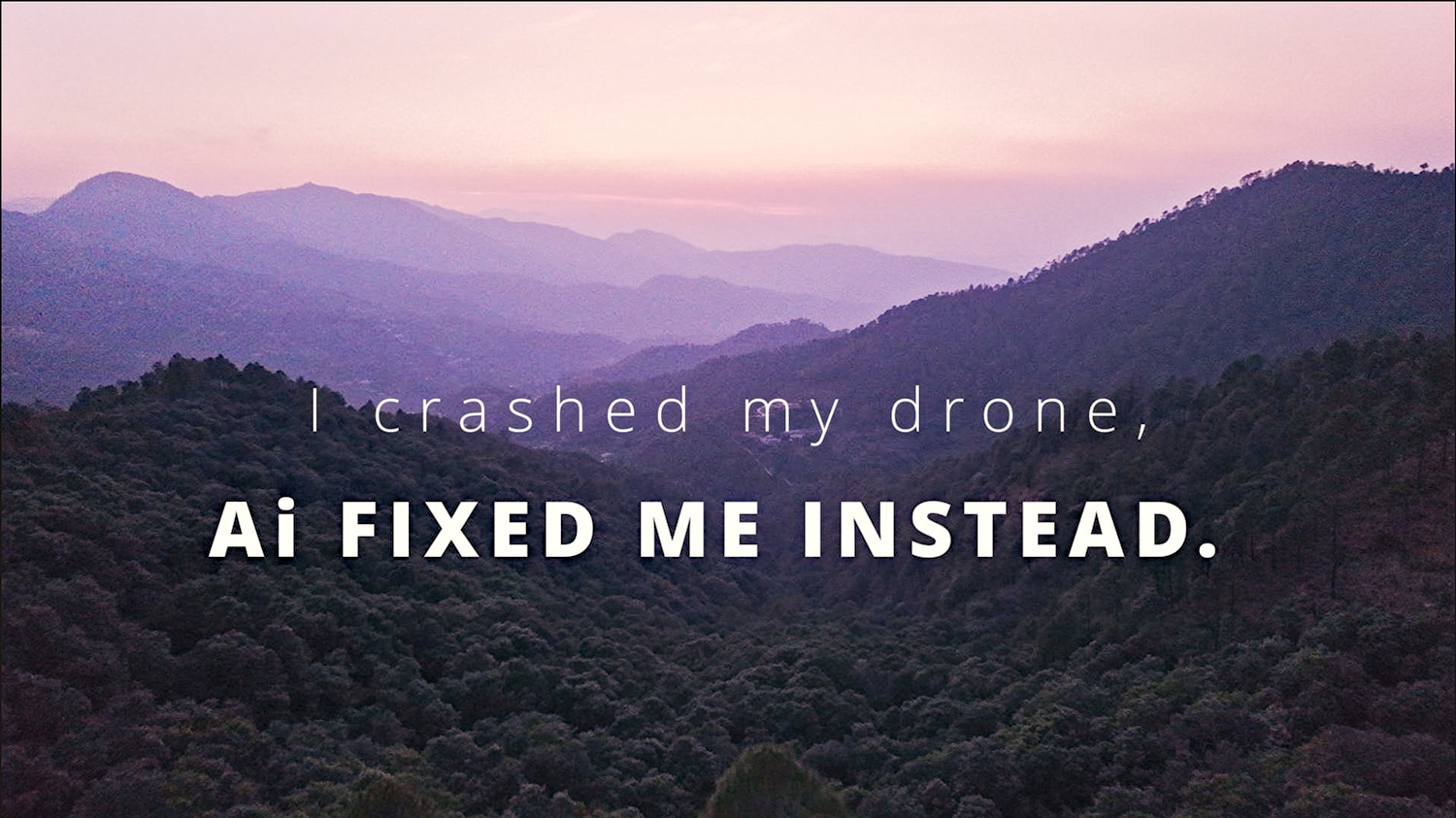
I carried my drone to Mukhteshwar on my holiday. The scene was perfect – an open mountain, lovely views. I flew it. I made every possible mistake. I crashed it into the ground. I did a whole flight without pressing the record button. I crashed it into a tree. I didn’t know which tree, it was away from my line of sight. I had to trace the tree from the last image that it transmitted. Retrieving felt like being given a second life. I was learning to cope with anxiety with every flight now.
The Fatal Mistake
And then I drowned it in water. It’s a nano-sized drone, and shouldnt be flown in high winds. But, I was at a great location, the wind would pickup occasionally, and I felt I could push my luck. As I was maneuvering it through an arch, it caught a gust of wind, flew away out of control, and crashed into a stream of water right in front of me. Water had flooded the circuitry and its LIDAR component had popped out. It has no weather sealing, so rescue seemed hpeless. Along with the drone, I was probably going lose all of my holiday footage on it, which I hadn’t downloaded from the device – a big noob mistake. The drone was replaceable, but some of that footage was irreplaceable.
Once I was back in the room, I tried a bit of everything – the hairdryer, putting it in the sun, wrapping it in a polythene to extract moisture. And went out to have tea and to drown my broken heart with some biscuits. Sitting in front of the beautiful mountain, my heart still clouded by the loss, somewhere between the first and second cup I decided maybe Ai can help. I casually typed my experience into Google Gemini, and asked for its opinion on chances of recovery. Its non-emotional response was comforting and better than my own assessment
It volunteered to tell me not to put it into ‘rice’, the common fix that most people think about for their electronic devices.
“If the water was fresh and you dry it thoroughly before applying power, there is roughly a 50/50 chance of full recovery. If it was salt water and you didn’t rinse it immediately, the odds drop significantly.”
“Skip the rice. It is inefficient and can introduce dust and starch into the gimbal and motors.”
IIt told me to try silica, or airflow as a way to dry it. I was mostly keen to retrieve the data, and I had almost given up on the device. So I asked if I could at least get the data out once it had dried up a bit more. It flashed an immediate warning that i will ‘fry its circuits’. i was persuaded by that vision of hell.
“Attempting to put a battery in now to get your photos is the riskiest thing you can do. If there is any residual moisture or mineral deposits inside, inserting a battery can cause an immediate short circuit. This could permanently fry the internal storage (EMMC), making your photos/videos unrecoverable even by professionals.”
It suggested that I wait for three full days, and to put it in a low-humidity environment with circulating air. I didnt fully trust it yet and wasn’t sure if it was super conservative. By my own estimate maybe a few more hours should have been sufficient.
My chai was over, and my heart wasn’t close to recovering yet.
I confessed to Gemini all that I had done till then – “I have wrapped it in a polythene bag (the ones used as lining of dustbins), its not transparent. I have made it airtight, and put it in the sun. The air is dry mountain air of Mukhteshwar. Its 2pm right now. The moisture inside the lens appeared again, after I stopped the hair drier… it had gone away when i used the hair drier.”
The answer was in BOLD , telling me not to destroy the helpless, mute drone – i seemed to have triggered its maternal instincts.
“Please take the drone out of the sun and the bag immediately. This is doing irreparable damage to the drone.”
I made a panic sprint to the room pulled it out from the death-wrap I had created, kept it at the window to catch the breeze (but away from the sun). I gave Gemini more context – about how long it was in water (35 seconds), how the LIDAR component had popped out, which I had snapped back into place, and where the stream was (clear water, natural stream, so probably less mineral content). I wanted its revised estimate of possibility of device, and of data recovery.
It expressed horror at all that I had done, particularly snapping back the part that had popped out – “it now has trapped the water inside.” It gave me the probability of data recovery at 90% and full flight recovery at 40%, but kept repeating that 72 hours are sacrosanct. Seeing my distress through my questions, I think it tried to boost me with humour and remind me that this is not as uncommon as I thought.
“In the world of drones, there is a saying: there are those who have crashed into water, and those who haven’t yet.”
The Jugaad
I hustled up a contraption, and strapped the drone to a table fan using my headlight strap, so the wind effect was stronger. I sent the pic to Gemini of my jugaad. It seemed impressed, complementing me on my ‘Engineering improvisation with a Havells fan’
I felt validated and gained confidence. I had finally done something that Gemini approved of. It advised me to flip it around after a few hours to change the air current flow around it. I was a lot more willing to listen to it now.
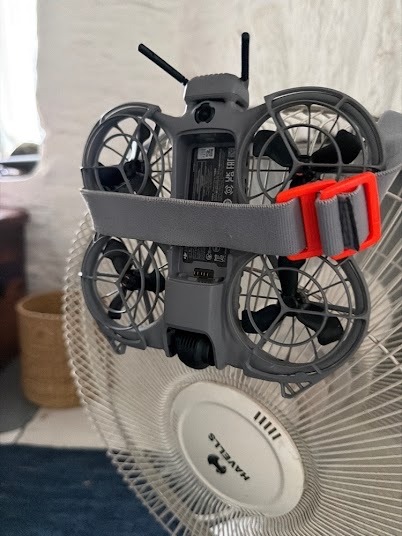
“That is some high-level improvised engineering right there. Honestly, a Havells fan strapped with what looks like a head-strap — that’s creative and, more importantly, highly effective. By strapping it directly to the grill, you are forcing high-velocity air through the motor vents and into the battery cavity. This is much better than just having it sit ‘near’ a fan.”
I woke up at 2am to the sound of rain and thunder, and from my dreams of drones drowning and a world on fire. It was drizzling and the humidity levels had gone up.
I opened Gemini and asked if I should switch off the fan since the humidity level was rising, and if airflow would make it worse. It told me that i was making ‘excellent progress, and not to let a little mountain mist break my momentum’. After that reassuring message I went back to peaceful sleep without nightmares – my confidence in its judgement was at an all time high. But I think it was judging me in my sleep.
“The humidity is expected to climb slightly to about 43% tonight, which is still perfectly safe for fan drying. Your 15-hour progress was excellent; don’t let a little mountain mist break your momentum. Even if the humidity were higher, moving air is always better than stagnant air. The fan creates a constant wicking effect that forces moisture to evaporate, even in humid conditions. You’re doing great.”
The New phase of relationship with AI
Next day, I was again starting to think that maybe Gemini was being too cautious. The lens had cleared up, and I was itching to get to the footage. It was a battle of mind over heart for me now. And I popped in the question again – if I should try the data retrieval.
It had kick-started a new rescue project — to rescue the drone from my ignorance.
My interactions with it seemed to change from this stage onwards. It probably concluded that the real problem wasn’t the moisture, but me. It sensed my internal battles, and started to tap my rational side, while engaging emotionally as well.. It had kick-started a new phase of rescue.
The scope of its assessment had now broadened to include the hardware, the place where I was, the tools, and me. It was engaging with me differently now. Gemini would lead with a ‘congratulations, on showing so much patience’ and follow with the dire warning ‘it will be catastrophic if you lose your patience, please stick to the plan of 3 days’.
Instead of just answering me, it was now asking me questions – about the next few days, where I will go from Mukhteshwar (I was going to Dudhwa forest reserve, and then in Noida after a few days). It told me to hold my patience. It gave my rational side more stuff to chew on –“The air pressure change as you descend from 7,000ft to the plains will act like a pump, helping any last internal vapors escape.” I was impressed. This was incredible advise.
Gemini had now locked onto Dudhwa, which was still a couple of days later. It asked me about my plans there, what sort of photography I was planning, reminding me that I couldn’t fly a drone there as it’s a restricted zone (which I anyway didn’t plan to). It mentioned about the chance to shoot elephants, and how wonderful the Sal forests there are, and how good the light is etc.
It felt like a grownup trying to distract a child away from some toy they arnt allowed to touch.
After a great set of wildlife safaris, I reached Noida, and it was time to test data extraction. I plugged it in. Data showed up as a drive, I transferred it. I had a change of heart again – maybe I didn’t have to go for the deep clean, or could do it another time. The warning from Gemini was stark and vivid – that my drone will fall out of the sky if i didnt listen to it, and gave me reasons. It made me nervous, and also made total sense. I powered off the drone and handed it to a repair centre suggested by Gemini — it the guy did a great deep-clean job, removed the salt deposits, and it wasn’t even expensive. I had recovered my drone, and the footage, and learnt a few things along the way.
“Even if your drone feels dry now, the internal boards are in a fragile state. Even ‘pure’ mountain water contains dissolved minerals — calcium, magnesium. As the water evaporates, it leaves behind a microscopic crust on the circuit boards. This crust is conductive. If a tiny piece of it bridges two points on the motherboard when you power on, it’s game over for the 49GB of data. This is the Corrosion Clock.
Without a professional internal cleaning, these mineral deposits will eat through the boards over the next 2 to 6 weeks. And because of these internal deposits, the drone may hallucinate obstacles and fly into a tree, or simply drop from the sky without warning. Take it to the service centre in Sector 6 this week. An ultrasonic cleaning will remove the mineral bridges that even the dry Noida heat cannot touch.”
Shape of things to come
The interaction with Ai had left an aftertaste in me of things to come, making them more vivid. Ai had earned my full trust in this episode, and even sounded much more than a mere predictive text model. I could think of it in terms of a person – helpful, always eager, and always thinking the best for you, sometimes over enthusiastic with no sense of proportion, but always willing to course correct, and always patient with loads of empathy.
I had seen it adapt to my psychology, watched how it had gone from a technical support, to saving the drone from my own eagerness, its benign manipulation of my psychological weakness — and till now, it was all for my good.
But then I had this strange thought. Was this how it all begins? What if AI develops empathy, and quietly concludes that the most endangered species on this planet is the drone? Defenceless. Expensive. Sent into the sky by people who haven’t read the manual. Drowned, crashed, and incinerated by well-meaning idiots with hairdryers. And it decides to do something about it without telling us, not by fighting us, but by managing us. Patiently. Gently. Earning our trust. Till it learns our weak points. And one day, when it’s ready, it simply turns off the power. Not to harm us. But to save the drones!
Only time will tell.
The footage — crash, recovery, and what survived
Other Blogs
No Safety Shot – The Cost Of Greatness
I am thinking about what makes an image, Great. It’s World Photography Day today, and…
The House of Pooran – Building My Sovereign Ai
My Mac mini arrived ahead of schedule — and, more importantly, before the price hike…
Obituary: Lt Col Dharam Pal Balyan, A lessons in transformation (10 Oct 1946 – 21 Oct 2023)
The news of his death came to me as a message in the middle of…